
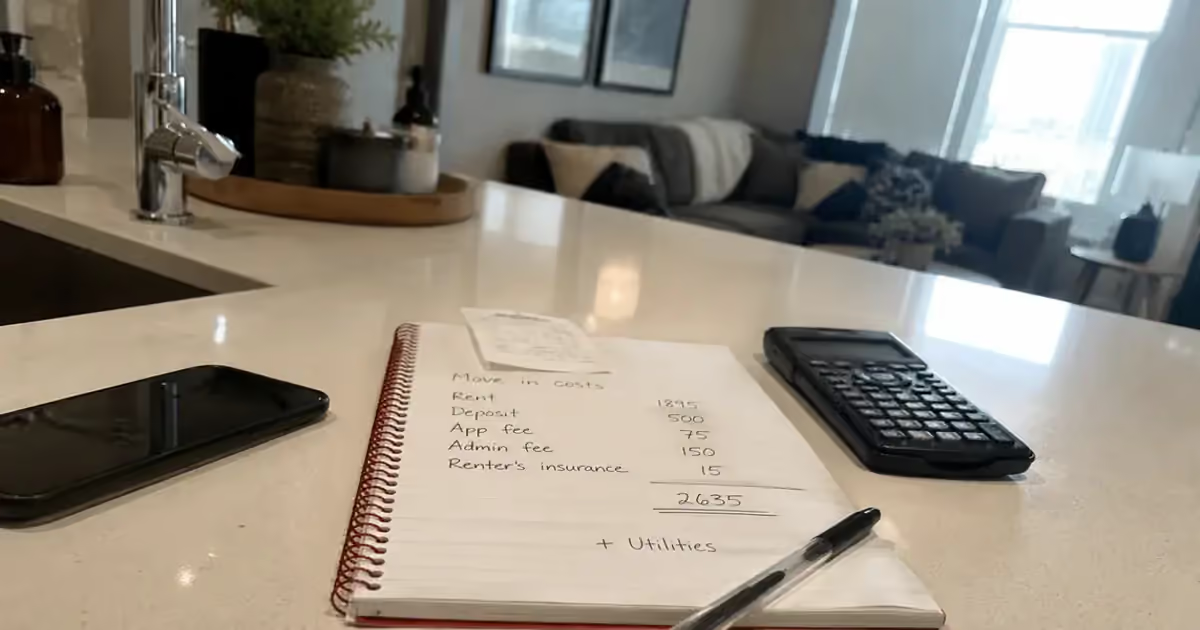
After approval comes the lease desk, and that's where a lot of moves stall over cash. The total cost to move into an apartment with bad credit often runs thousands of dollars more than people budget for.
Fort Worth apartments average $1,453 a month (RentCafe, August 2026), and that’s what most people budget for. The upfront move-in number is a whole different animal. We walk through these costs with you as part of second chance apartment locating. That way you have a working number before you book a tour.
Line by line
We start with the standard charges that hit before you even get keys.
- Application fee ($40 to $85 per adult): You pay this for each adult, and you don’t get it back, approved or not. Two adults applying to three properties can quickly spend up to $510 they won’t see again.
- Administrative fee ($100 to $250): Most communities charge this once at approval. Always ask if they’ll waive it when a new building is filling up.
- Pet fees: Expect $200 to $500 per pet that you don’t get back. That usually comes with $20 to $50 a month in pet rent.
- Renters insurance ($10 to $25 a month): Many Texas leases require an active policy before they release the keys.
When a property approves a file with weak credit, it often stacks extra charges on top. Here's what those look like.
- Security deposit ($0 to 2x rent): A clean file might only need a few hundred dollars. A conditional approval often doubles it. Texas Property Code Chapter 92 doesn’t cap security deposits, so a $1,453 unit can ask for a $2,906 cash deposit. By law, the landlord has to refund it, minus any deductions, within 30 days after you move out and give a forwarding address. This is general information, not legal advice, and we’re not attorneys.
- Risk fee ($0 to $750): Some conditional approvals add a monthly charge you don’t get back in place of a bigger deposit. Others charge a flat risk fee up front. At $50 a month, a monthly fee adds $600 over a year.
- Guarantor premium (about one month’s rent, paid once): Guarantee companies like TheGuarantors or Leap charge this premium, and you don’t get it back. On a $1,453 unit, that’s a single payment of about $1,453.
- Deposit alternative (a fraction of the standard deposit): Jetty, Rhino, LeaseLock and Qira swap a big cash deposit for a smaller fee you don’t get back. Obligo works much the same way, using a billing authorization on your bank account.
- First month’s rent: You pay the full amount. If you move in mid month, it’s prorated.
First: approval problem or cash problem?
We always start by figuring out whether you have an approval problem or a cash problem. The tools aren't interchangeable, and picking the wrong one wastes money.
- Approval problems: If the property turned down your application, you have an approval problem. Only a lease guarantee, a co-applicant, or a different property fixes a denial. Bringing more cash to a management company that already said no does nothing.
- Cash problems: If the property approved you with conditions, like a doubled deposit, you have a cash problem. A deposit alternative can handle that kind of approval for less money upfront. It usually costs a fraction of the deposit it replaces.
Which one is yours? Knowing exactly why you were flagged tells you which tool to pay for.
Three worked scenarios
Assume a $1,453 unit (the Fort Worth average, per RentCafe, August 2026) with one adult applicant and no pets.
| Line item | Clean approval | Conditional (double deposit) | Guarantee route |
|---|---|---|---|
| Application fee | $60 | $60 | $60 |
| Admin fee | $150 | $150 | $150 |
| Security deposit | $400 | $2,906 | $0 to $400 |
| Guarantor premium | $0 | $0 | $1,453 |
| Risk fee (first month) | $0 | $50 | $0 |
| First month’s rent | $1,453 | $1,453 | $1,453 |
| Cash at signing | approx. $2,063 | approx. $4,619 | approx. $3,116 to $3,516 |
Two things jump out from this table. First, the gap between a clean approval and a conditional one is more than $2,500. Knowing where you stand on criteria ahead of time saves real money.
Second, the guarantee route comes in about $1,100 to $1,500 under the double deposit here. And it can open up communities that a doubled deposit can’t get you into.
Refundable isn't the same as cheap
You get a doubled deposit back at the end of the lease. That sounds better than paying a premium you never see again, but it ties up $2,906 you can’t use for twelve months. It doesn't help you buy a bed, pay for a truck rental, or cover a gap in pay. And move-out deductions for cleaning or repairs are very common. Treat cash at signing and total cost over the lease as two separate questions.
Deposit alternative, guarantee or larger deposit, compared
Here's the real cost of each option on a unit that rents for $1,453 a month, next to a property that advertises no credit check. The “Changes approval” row is the one that matters most of the time.
| Deposit alternative | Lease guarantee | Doubled cash deposit | No credit check property | |
|---|---|---|---|---|
| Cost at signing | ≈ $150 to $430 | ≈ $1,453 | ≈ $2,906 | A deposit of one to two months’ rent |
| Refundable | No | No | Yes, less deductions | Yes, less deductions |
| Changes approval | No | Yes | No | No credit pull to pass |
| Opens Class A buildings | No | Often | No | No |
| Accepted where | Depends on the property | Management company policy | Everywhere | A small set of properties |
| Best when | Approved with a deposit condition | Declined on credit or income | You have the cash and want it back | You have no credit file and the cash for a big deposit |
Properties that don't check credit usually charge one to two months of rent as a deposit, a cushion against a risk they can't measure. On the same $1,453 unit, with the same fees as the scenarios above, that puts cash at signing around $3,116 to $4,569. At a standard property with a deposit alternative, it lands around $1,813 to $2,093. Over a full lease the gap shrinks, since most of the deposit comes back to you. That only helps if you had the cash to hand over in the first place.
We see deposit alternatives accepted at many communities, including mid range and Class A properties across Tarrant County. True no credit check properties are much fewer, so you get fewer choices. They do exist, and for some renters they're still the right answer.
The guarantee premium often catches renters by surprise at signing. It buys a legal promise to cover the rent, which lets a property approve a file that failed its screening. Two things people get wrong about it:
- It isn't insurance: If you stop paying, companies like Leap or TheGuarantors pay the property and then come after you for the balance.
- It isn't an approval guarantee: The property management company still makes the final decision on your file.
Our guide to how guarantor programs work covers who qualifies, what happens at renewal and whether you get anything back.

The monthly risk fee trap
Some properties offer a monthly risk fee instead of a larger deposit. It looks harmless at first, since the monthly number is small. But $50 a month totals $600 over a year and $1,200 over two years.
This fee isn't refundable, and it doesn't go down over time. Next to a $400 deposit alternative paid once, a $50 monthly fee costs one and a half times as much over a 12 month lease. Over two years, it costs three times as much. Some deposit programs, like LeaseLock, bill monthly too, so do the math over the whole lease.
- Multiply any monthly charge by 12 to see the real yearly cost.
- Ask the leasing office whether the fee keeps going at renewal. If it does, the total doubles.
Using two tools together
We often see applicants use a guarantee and a deposit alternative together. That's not paying twice for the same thing. Say a renter is turned down on credit and uses a guarantee to get approved.
The property approves them but often still wants a doubled deposit. The renter then uses a deposit alternative to avoid tying up $2,906 in cash. Each tool solves a different problem.
Ask the property if they allow this combination. Some management companies still insist on a cash deposit on top of a guarantee.
Concessions, and the renewal cliff
When a new building is filling up, rent specials can wipe out a big part of these costs. Take a two bedroom at $1,602, the Fort Worth average for that size (RentCafe, August 2026). Six weeks free is worth about $2,200. Admin fees and deposits often drop at the same time.
That’s a good reason to time a move around a lease-up. The downside shows up at renewal, in what the industry calls the renewal cliff.
Spread a concession across a twelve month lease and your average rent (the net effective rent) lands well below the rent on the lease (the face rate). At renewal, your rent jumps back up to the face rate.
- Face Rate: The monthly rent written on the lease ($1,602).
- Net Effective Rate: What you pay on average once the six weeks free are spread out (about $1,417).
- The Renewal Jump: At least $185 a month more in year two.
We bring this up whenever a special is on the table. Budget for the higher face rate from the day you sign.
Questions to confirm before you sign
Go through this checklist before you sign anything. Skip it, and the surprise fees show up later.
- Which programs does the property accept, and when was that policy last updated?
- Does the deposit alternative here replace the deposit entirely, or only part of it?
- Is the premium a single fee or a monthly charge?
- If a guarantee is used, is the deposit reduced or waived?
- Does the management company cap extra risk fees, for example at half a month’s rent?
- Does any fee repeat at renewal?
- What's the total cash at signing, all in?
What isn't on this list
Our fee isn’t in this breakdown, since we don’t charge one. The consultation, criteria research, and paperwork help cost you nothing.
We give you an estimate of move-in costs for any community we send you, and the lease has the final numbers. You can run your own estimate with our renter tools before you talk to anyone on our staff.
The ranges here are typical for Tarrant County as of 2026. They’ll vary by property, unit, and season. None of this is an approval decision or an offer of housing. The community always decides who gets approved. Knowing your total move-in number ahead of time just means the bill at signing doesn’t come as a shock.