
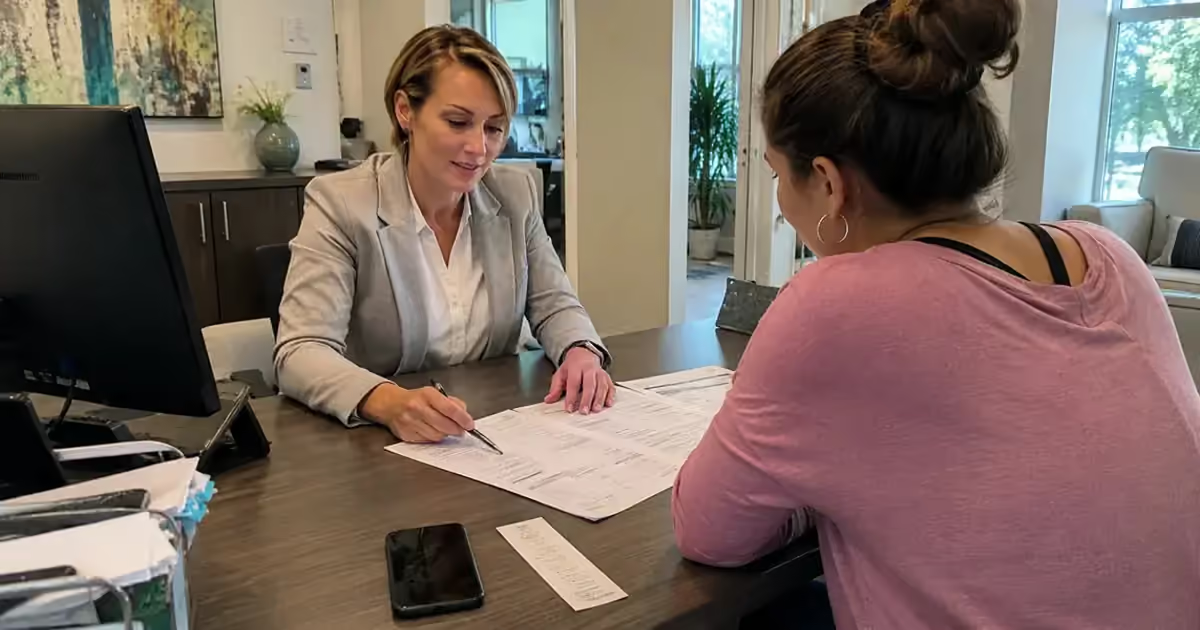
Rental approval can feel confusing from the outside, like one big wall. Look closer at any property's criteria and you'll find six separate gates.
Once you understand the screening criteria, you can fix the real problem instead of guessing.
We use the same six part breakdown in the rest of our guides, and in our free second chance apartment locating to match your file against the communities in our own database. If you have an eviction filing, start with apartments that accept evictions.
A lot of applicants we see have a money gap, not a history problem. For them, guarantor programs often solve it.
Apartment screening criteria explained: The six things every application is scored on

Every application gets checked in six categories, and failing just one can get you denied. Here's what each one covers.
1. Eviction lookback. Properties decide how far back they check court filings, and whether they look at how the case ended or just that it exists. Tarrant County has eight Justice of the Peace (JP) precincts where these get filed. Around here, lookbacks run from one to seven years.
2. Rental debt policy. In the denials we see, this one causes more trouble than applicants expect. The question is whether you need a zero balance, whether a payment plan on paper is enough, or whether they'll look at an open balance.
3. Income multiple. The usual rule is that your monthly income before taxes has to be three times the rent. Some communities in Tarrant County use 2x or 2.5x instead. How properties check income has changed too. Many now run pay stubs and bank statements through document software like Snappt to catch edited files, so send the originals.
4. Credit threshold. We keep track of each property's minimum score. Many properties use their screening company's own rental score instead of the FICO score a lender would use. A lawsuit has already put limits on these automated scores. In a 2024 class action settlement, SafeRent agreed to stop sending approve or decline recommendations for renters who use housing vouchers. The one exception is a model that outside civil rights experts have checked for fairness.
5. Background policy. Properties set rules on the type of offense and how many years have passed since the case ended. Either software applies the rule, or a person does an individual review of your file.
6. Third-party programs. We track which lease guarantee and deposit alternative providers a community accepts. This counts as its own category, since it changes what the other five can forgive.
The short version
Approval comes down to six separate tests. Failing one is usually fixable once you know which one it was.
Who sets them, and who can bend them
Three different things get called “criteria,” and each one works differently. We often see applicants spend time making their case to front desk staff who have no power to override the system. Knowing who decides what saves you that frustration, so we sort the decision makers into three layers.
Screening Software Rules
These rules live inside big screening systems like RealPage or Yardi. Your data goes in, a recommendation comes out, and the on-site team applies it. At this stage, a person rarely reads your explanation. The software makes the call.
Management Company Rules
This layer sits above the software. Big management companies like Greystar, Willow Bridge, RPM Living, and Asset Living set rules for every property they run. Those rules cover lookback periods, balance rules, and which programs they take. That's why a company that takes a guarantee program at one property usually takes it at all of them.
When the Local Manager Decides
This last layer is whatever's left, and it varies a lot from place to place. At older, locally managed properties, managers often have real room to bend the criteria. Class A properties run by big companies usually don't allow local overrides.
That doesn't mean Class A properties are always harder to get into. Those same corporate properties often work with guarantee programs. With a guarantee, a record that an older, locally managed property might turn down can still get approved. The route is just different. Where a person reads the file, your explanation and background can work. Where software decides, financial tools like a guarantee work better.
Why criteria move, and how we keep up
Dallas-Fort Worth has a big wave of new apartment buildings opening right now. When the market moves this fast, what properties require for approval moves with it. We hear about those changes from leasing teams every day, and our database moves with them.
Yardi Matrix's July 2026 Dallas-Fort Worth report put established properties at 92.3% full, and asking rents were down 1.6% from a year earlier. New supply is running ahead of demand. Big new projects keep breaking ground around Fort Worth, and each one adds units that need renters.
Why New Buildings Say Yes More
A building taking its first residents is under heavy pressure to lease units, so it has a strong money reason to approve people. During these first months, criteria usually sit at the softer end of what the owner allows. Rent specials run heavy right now too. Once the building fills up, management goes back to stricter rules.
Why an Old Answer Can Cost You
All this change is why we update our database as we talk with leasing agents and property managers every day. An old answer about a new building is worse than no answer at all. It sounds specific, but it might be way out of date. Ask the leasing office when a policy was last updated. It's a fair question, and the answer tells you a lot either way.

How the six categories work together
In real life, these six categories don't stand alone. They overlap, and that overlap gives you room to plan. Here's how one can make up for another.
| If you fail | What can make up for it | Where that works |
|---|---|---|
| Credit threshold | Strong documented income, or a guarantee | Most property types |
| Income multiple | A 2x/2.5x community, co-applicant, or guarantee | Available at some communities |
| Rental debt policy | A settlement letter, or a documented plan | Properties that take payment plans |
| Eviction lookback | A property with a shorter window, or a guarantee | Depends a lot on the company |
| Background policy | An individual review, with paperwork | Properties that run that review |
At some properties, strong income makes up for weak credit. Elsewhere, it doesn't help at all. An old eviction filing with an open balance often screens worse than a newer filing with a zero balance. The open balance fails a second category, and two failures at once often mean an automatic denial. That's why you have to check your options property by property instead of going by general rules.
Getting Your Paperwork Ready
A good next step is seeing exactly what the property will see. Our guide to pulling your own tenant screening report walks you through requesting your files. You'll want your Experian RentBureau, SafeRent Solutions, and TransUnion files, plus a Tarrant County JP court records search. Look them over at least 30 days before you apply anywhere. That way, if you find an error, you have time to dispute it before a leasing agent sees it.
Planning the Search
Once you know where you stand in all six, the search stops being a guessing game. Knowing the criteria never guarantees approval, and the community always makes the final call. But applying only where your file fits the written criteria beats applying and hoping.