
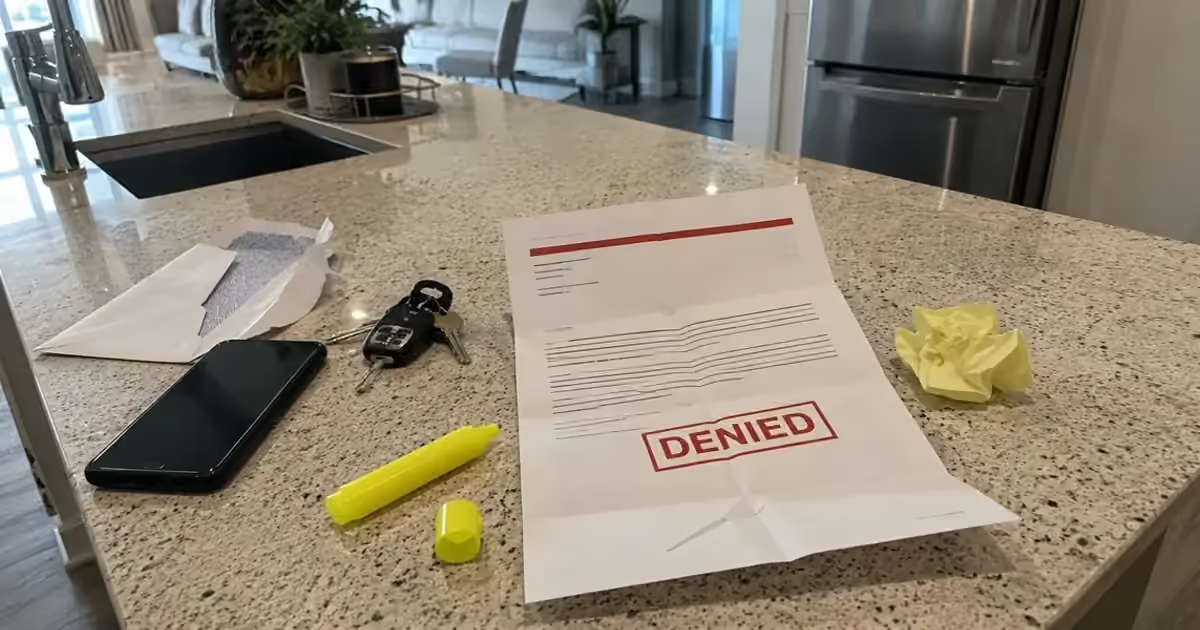
What to do right after a denial, when the details are fresh
A denial feels like the end of the search. Handled right, it tells you what to fix before the next application.
The trick is getting those facts before you give up and move on to another listing site. It starts with one document that most applicants we talk to never asked for. If you'd rather not do it alone, we work through these same steps with you in our free second chance apartment locating.
Here's why denials happen and what to do about each one.

Step one: get the adverse action notice
Ask for your adverse action notice right away. This notice names the screening company they used, like TransUnion or Experian RentBureau, and tells you your rights. If a credit score played a part, it has to list the score and the main things that hurt it.
We always start here. Under the Fair Credit Reporting Act, you have 60 days to ask that company for a free copy of the report. Once you know which file the property looked at, you know which one to check. A short email to the leasing office asking for it is a normal request.
We see applicants waste hundreds of dollars applying blind, with no idea why they were denied. Every application fee is money you don't get back, often $40 to $85 per adult. Guessing gets expensive fast.
The rule that saves you money
Don't send a second application until you know which part of the criteria you failed. Fixing the wrong thing costs another $40 to $85 and tells you nothing new.
Step two: sort the denial into a category
Every denial falls into one of five buckets, and each one needs a different fix. We sort every denial into these same five before we suggest a next step. The goal is to match the reason to the fix, not to try the same thing somewhere else.
The most common move we see is applying the same way at a similar property, and it rarely works.
Base your next move on the middle column below.
| Reason for denial | What actually changes it | What doesn't |
|---|---|---|
| Credit below threshold | A lease guarantee, or a property with a lower minimum score | A bigger deposit at the same property |
| Income under the multiple | A 2x/2.5x community, co-applicant, or guarantee | Reapplying with the same pay stubs |
| Eviction filing | A shorter lookback window, or a guarantee | Explaining it to an automated system |
| Balance owed | A settlement letter, or a property that will look at an open balance | Promising to pay it later |
| Background policy | A property that does individual reviews | A letter at a property where software decides |
For example, TransUnion’s ResidentScore rates risk differently than a regular FICO score. If you fail a ResidentScore check, you need a community that uses a different score or accepts guarantor companies.
Our database notes which score a building uses, so we can point you to one that scores you differently.
Step three: change the variable that matters
The fix has to match the reason you were denied. A money gap gets solved with a tool like a guarantee. A history gap gets solved by finding a property whose rules fit your history.
So which gap is yours? Here's what works for each one:
- A financial gap: Low credit or not enough income gets fixed with a financial tool. A third-party lease guarantee changes how the property sees the risk. Companies like TheGuarantors or OneApp Guarantee charge about one month's rent, paid once, to back your lease.
- A history gap: An eviction filing or an old balance gets solved by finding a property whose rules fit it. A community that checks three years back usually turns down a filing from two years ago, no matter how you explain it.
- A documentation gap: This is the easiest gap to close. Maybe you have the income but not the right proof, or SafeRent listed a dismissal as a judgment by mistake. To catch this kind of error, start by pulling your own screening report.
Dispute any error fast. Fixing it clears the way for your next applications.

When it's worth asking the property to reconsider
Asking them to reconsider costs nothing but a phone call. Sometimes it works. Only ask if a real person makes the call and you have new facts you can prove.
In our work, smaller, locally managed properties are the most open to a second look. You'll need real proof for it to work. A letter about hard times rarely changes the answer on its own. Bring one of these instead:
- A lease guarantee from a company like TheGuarantors, now in place.
- A strong co-applicant added to the application.
- A settlement letter for a balance that used to be open.
- Court paperwork showing how a case really ended, when your screening file got it wrong.
Skip the override request if a large community uses software to decide. The leasing staff usually has no way to reverse the software's denial. Put that energy into finding a property whose criteria fit you.
Step four: prescreen the next one
A denial stings: you pay the $40 to $85 application fee either way. Prescreening cuts that risk by checking the requirements before you pay.
Confirm these before you hand over a credit card:
| What to Check | What to Ask the Landlord |
|---|---|
| Money Minimums | The minimum credit score, and how many times the rent you need to earn. |
| How Far Back They Look | How many years they check for evictions or broken leases. |
| Guarantor Policies | Whether they accept lease guarantee companies like TheGuarantors. |
| Background Rules | Whether a person reviews older records one by one. |
Property requirements change all the time, depending on how full the building is.
That's why we keep our own database of Fort Worth communities and update it as we talk with leasing agents and property managers every day. Texas law helps here too: Property Code Section 92.3515 requires landlords to make their written selection criteria available when they give you the application.
We match your file against that database for free. If you want your next try to be based on facts instead of hope, start your search and send the adverse action document with it.
One honest warning. Nobody can guarantee approval, and we won't either. The final screening decision always belongs to the community.
Good prep improves your odds, and at $40 to $85 per adult on every try, that matters.